
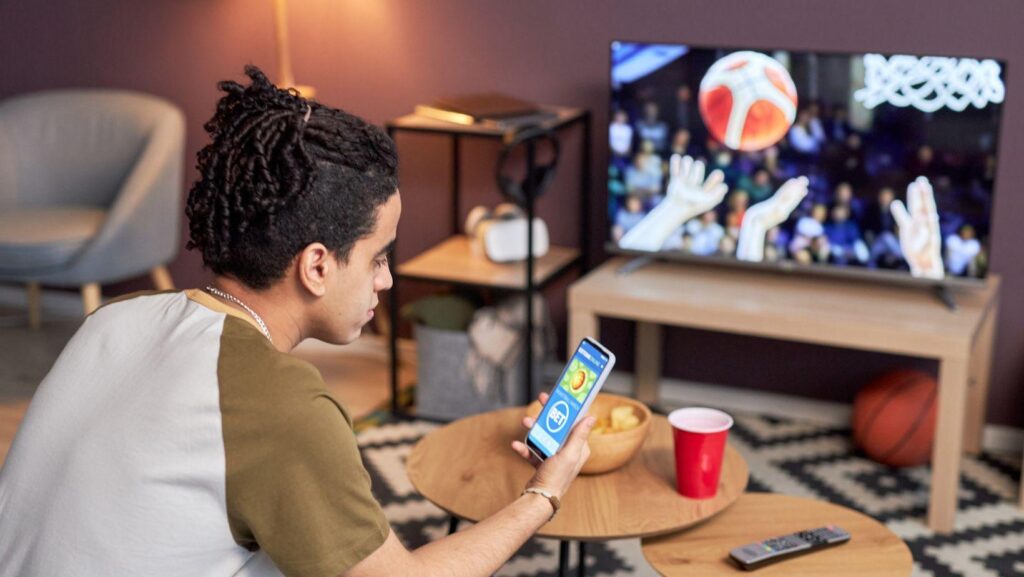
Picture a Sunday afternoon at a crowded sports bar in Austin or a living room in Fort Worth during the fourth quarter of a close NFL game. Some fans watch the broadcast while others follow live win-probability graphs, real-time player tracking metrics, and shifting point spreads on their phones. Even though state-licensed retail and online sportsbooks do not operate within Texas borders, sports wagering interfaces form part of the wider digital environment in which Texans follow games and debate strategy.
Sports betting technology is no longer confined to placing a wager. Odds feeds and interactive interfaces now sit alongside player tracking and analytical tools in sports media. These technologies serve overlapping purposes; not every tracking system or statistical model originated in wagering. For casual viewers and die-hard supporters alike, watching a game has become a far more granular, data-driven experience.
Broadcasts Built Around Real-Time Odds and Micro-Events
Traditional sports broadcasts used to focus on broad narratives, basic box scores, and occasional injury updates. Today, pregame shows, halftime panels, and live tickers regularly integrate implied probabilities, over/under totals, and player prop benchmarks directly into their visual layouts. Fans watching college football Saturdays or NBA matchups in Dallas, Houston, and San Antonio routinely see point spreads and live win-probability curves displayed right alongside the score bug.
High-speed data pipelines combine tracking and play-by-play information. The NFL's Next Gen Stats system, for example, uses tracking tags to record player movement and derive performance metrics. Instead of waiting until the end of a quarter to evaluate how a team is performing against expectations, viewers can see immediately how a single third-down conversion, a pitch-clock violation, or a foul trouble rotation alters projected outcomes. Even fans who never place a bet use these numbers as a shorthand for game momentum, much like passing yards or shooting percentages were used a generation ago.
Second-Screen Apps and Predictive Engagement
A phone or tablet can provide a companion view of a game, with play-by-play information, prediction features, and player dashboards. Such services may use data feeds that also serve wagering businesses, but their models and update schedules differ. A television feed and a mobile score display may not show the same moment, which matters when interpreting an apparent change in momentum.
When fans look up how digital platforms structure odds, interfaces, and mobile usability, they may encounter commercial directories using labels such as "Texas sports betting sites". A directory is not a Texas licensing register, and its label does not establish that listed services may accept wagers from people in the state. Understanding how these platforms organize live data also helps explain why mainstream sports apps look the way they do today. Compact cards, changing numbers, and player-milestone trackers share screen space across different sports products. Similar layouts do not establish that their functions or legal status are the same.
How Texas Law Shapes What Fans Can Actually Use
Because Texas maintains strict statutory limits on wagering, the local fan experience looks notably different from states that authorize commercial sports wagering. Under Texas Penal Code Chapter 47, commercial sportsbook operations and online sports wagering remain prohibited in the state. Texas does not issue state licenses for commercial online sportsbooks or commercial real-money online casinos, and seeing a sportsbook logo on a stadium wall or a national broadcast does not mean an operator is authorized to accept wagers from inside Texas.
Location verification helps state-licensed wagering services enforce territorial restrictions. Depending on the service, checks can combine device-location and network signals to determine where a user is physically located. Reading a publicly available statistic or news article is distinct from being authorized to place a wager. Neither access to an app nor a payment option changes Texas law, and adjacent products should not be assumed lawful simply because they use terms such as fantasy, prediction, or entertainment. Readers checking a particular service should consult current official guidance rather than infer permission from its branding.
Stadium Upgrades and In-Venue Connectivity
The influence of real-time data technology is just as visible inside Texas stadiums and arenas as it is on television. Reliable venue connectivity matters when thousands of spectators want to check statistics, messages, or companion content simultaneously. Data-heavy services depend on more than a well-designed screen.
Companion tools may display shot charts, pitch velocity, movement metrics, or fantasy scores, but the available data and update timing vary by sport and service. Better connectivity can help spectators access companion information, although coverage, service availability, and delays vary. A venue screen can also ask spectators to predict a coming play as entertainment. A purely editorial prompt is distinct from a wager or a prize contest, and any contest should explain its eligibility and rules. Similar presentation does not make those activities legally interchangeable.
Smarter Fan Conversations and Data Literacy
Perhaps the most lasting change is cultural. Access to predictive analytics creates new opportunities for discussion, along with a need to distinguish estimates from facts. Conversations at tailgates, barber shops, and online forums routinely reference closing line value, expected points added, usage rates, and matchup-specific player props.
Rather than relying solely on highlight reels or gut instinct, fans cross-reference injury reports against sudden shifts in point totals to gauge how significant an absence truly is. When a starting quarterback is listed as questionable or a key pitcher is scratched, a change in projected totals offers one estimate of the effect. It may also reflect other news, assumptions, or market activity, and should not be treated as a measurement of the player's true value.
Where the Fan Experience Goes Next
Technology built for sports wagering has permanently altered how sports are packaged, analyzed, and consumed in Texas. Even while state law keeps commercial sportsbooks outside its borders, the underlying infrastructure of real-time telemetry, geolocation boundaries, predictive modeling, and interactive second-screen tools continues to define modern fandom. Whether watching from a living room in El Paso or cheering from the stands in Arlington, Texas sports fans are engaging with games through a sharper, faster, and more interactive lens than ever before.